
Dreams
a place where we become....
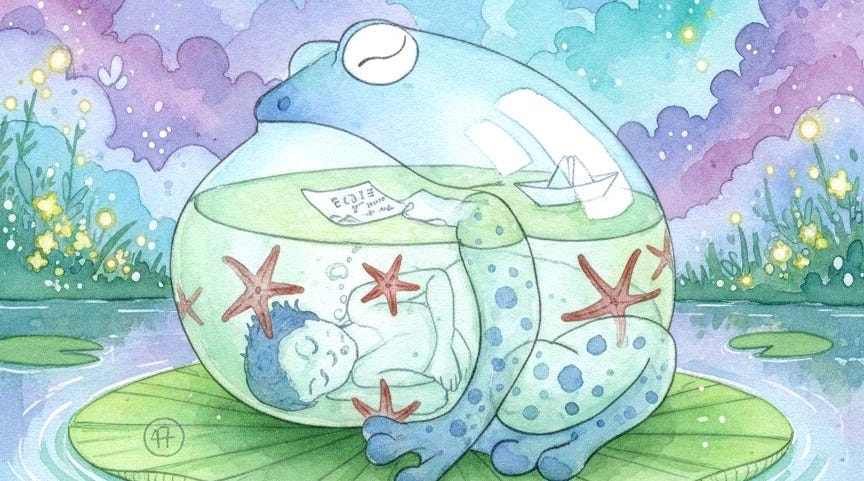
“A dream is a variety of thinking” — a quote whose origins I cannot recall but is an idea I cannot forget either. Personally and collectively, I think we can all agree that dreams as a concept is truly fascinating, because what do you mean when you say that the giant frog sitting at my dining table eating cereal, looking all annoyed, is a representation of my future self, tired of waiting for my courage to start something new? I made that up but it does feel psychologically plausible. Doesn’t it? So….if a dream is a variety of thinking, then what kind of thinking is it?
Let’s look at what data already has to offer —
From a psychoanalytic perspective, Freud (1900) described dreams as disguised fulfillment of repressed wishes, wherein the dream as we remember it, is the manifest content and the hidden unconscious meaning of it is the latent content. Jung (1913) was further able to categorize the manifest content into something we know as the archetypal language of dreams, which does not limit dreams to the personal unconscious but also the collective unconscious (psychic structures composed of inherited, universal patterns). Another understanding of dreams come from the activation synthesis theory which states that dreams are a result of the brain’s attempt to make sense of random neural activity that happens in our brain while we’re asleep (Hobson & McCarley, 1977). Similarly, there is another perspective that views dreams as a memory consolidation process wherein the brain sorts and strengthens new memories so that they’re stored properly to use later, and finally, we have the most popular problem solving perspective that suggests an enhancement of creative and cognitive abilities while we are dreaming.
Fun fact: the discovery of the use of insulin, part’s of the Frankenstein novel and the structure of the periodic table, are all ideas originated in one’s dreams or in hypnagogia (a dream-like transitional state between wakefulness and sleep).
Beyond these, we also have the threat simulation theory, which as the name suggests states that dreams provide a safe space to practice our responses to distressing or dangerous events for efficient threat avoidance (Revonsuo, 2000). This is also applicable to rehearsing socially difficult situations, such as a confrontation with an intimidating boss, which might otherwise make us feel anxious in real time. In short, dreams can be viewed as screensavers performing some function while our body rests.
Well, there’s actually a lot more to discover if you dig deeper into these theories and concepts. But what stood out from me is that across these frameworks, dreaming appears less like random/nonsensical imagery and more like a process that suspends realism to explore desire. Here, we simulate states that are not yet real; we place ourselves in positions not yet lived; and we test identities without committing to them. It frees us from our current limitations and lets us experiment with a multitude of possibilities. Now, why is that important?
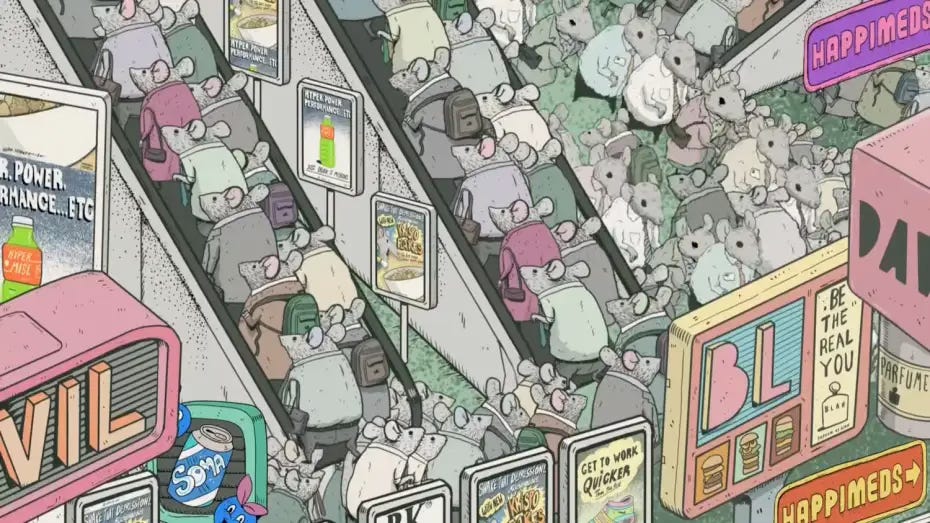
You see, in a world driven by constant notifications, an overwhelming amount of information, and the itch to optimize everything, we’ve left very little space for ambiguity. And dreams — eyes open or shut — resists that architecture and practices some kind of “useful incoherence.” Take a small segment from this vivid dream I had years back, that I remember clearly waking up feeling frustrated to:
I am at my grandparent’s place in Kerala and out of habit I have picked up the landline in the hall to let everyone know that I am in town but the buttons kept shifting and moving around. Every step felt familiar, yet the simple act of dialing became impossible. And in that moment of failure, I found myself powerlessly still.
Perhaps, it is in this surrender that we finally find ourselves outside the economy of productivity and performance, which I think is very liberating.
So, if a dream is a variety of thinking, then it may be the one that enables whimsy and wonder in an age of speed. It protects the psyche from becoming purely reactive and restores dimensionality. It is indeed a place where we truly become…..
absolutely anything!